

Before women’s rights were officially recognised, they had few shelters or safe spaces. Women’s monasteries were among the few places that could offer them refuge. Women could always turn to these institutions for shelter and medical assistance. Sometimes, poor women came to monasteries to give birth, or they left their infants there. St. Mary’s Monastery, which has endured much over the years, remains Birmingham’s most significant women’s monastery. Read more on birminghamka.
Invitation from the Bishop
In 1840, Thomas Walsh was the Bishop of the Midlands. To develop his diocese and provide aid to those in need, he and his coadjutor, Bishop Nicholas Wiseman, used their authority to invite the Sisters of Mercy to the area.
Together with the Sisters of Mercy, they established the monastery. Such efforts were always considered acts of charity and were often funded by parishioners. The land for the monastery was donated by Hardman & Co., a stained-glass manufacturing company. John Hardman, the founder, offered land opposite his private residence. He also covered part of the construction costs. Hardman & Co. was the largest stained-glass manufacturer in England, and Hardman himself had sufficient wealth to become a patron of the future monastery. He was joined by the Earl of Shrewsbury. Together, they hired the renowned architect Augustus Pugin to design the monastery, which was later recognised as a significant architectural landmark.
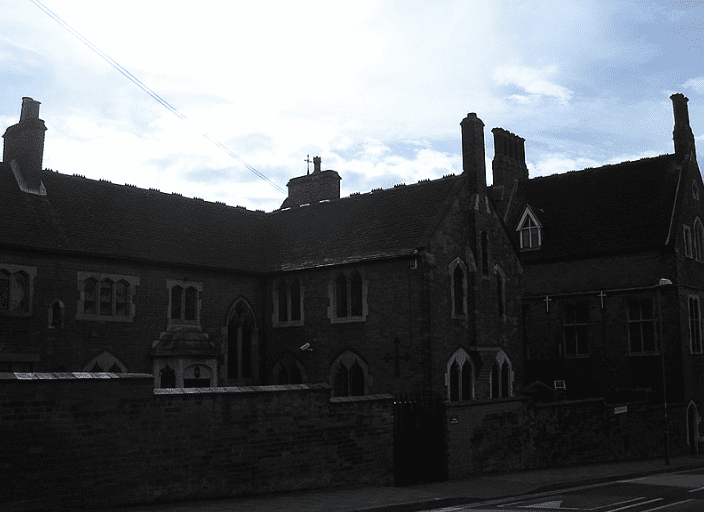
The monastery was officially opened in 1841 and served the parishes of Handsworth, Lozells, and Hockley. The chapel, which was part of the monastery, functioned as a fully operational church for a long time. However, a dedicated church was not built until 1847.
St. Mary’s Church
As the population grew, so did the number of parishioners. The small chapel could no longer accommodate everyone, creating an unsafe and uncomfortable situation. In 1845, a decision was made to build a separate church next to the monastery.
The construction lasted two years, and in 1847, Bishop William Wareing consecrated the new church. By 1894, an even larger church, St. Francis of Assisi, was built. St. Mary’s Church was then converted back into a chapel. Unfortunately, it did not survive World War II. The parish decided not to preserve its ruins as a historical site. Instead, the land was cleared, and a Catholic primary school, St. Francis Catholic Primary School, was built in its place.
The Mission of Monasteries
John Hardman and the Earl of Shrewsbury had a clear goal—to improve Birmingham by providing support for its impoverished population. Monasteries often served not only as religious institutions but also as shelters for the poor and homeless. Those in need could work in exchange for food, and the homeless were offered a roof over their heads in return for labour.
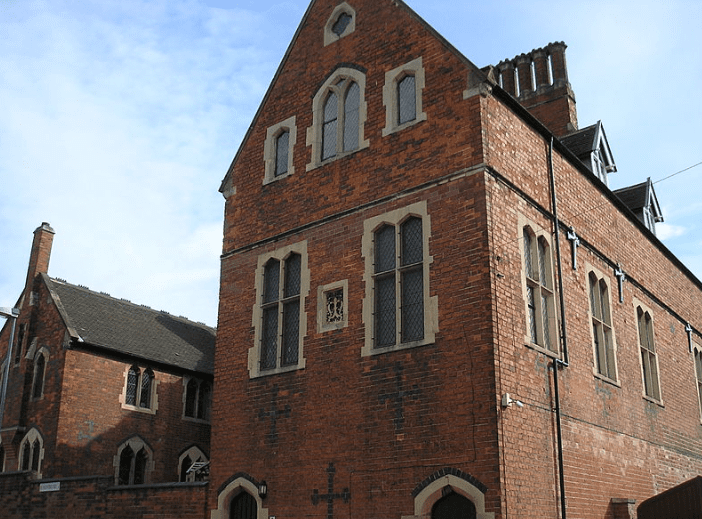
Until the late 1960s, the Sisters of Mercy operated an educational school within St. Mary’s Monastery. They regularly held special services with an educational purpose. This was the final initiative of Catherine McAuley. After her death, it was decided that the monastery would continue as a Centre for Spirituality and Partnership. One of its main initiatives was the Heritage Trail, which involved special services for women and children.
Each sister was responsible for a particular aspect of service. This became one of the first forms of general education for women in the area.
Sunday schools often served as the first educational institutions in the region. The level of education they provided was basic, typically focusing on scripture, reading, writing, and arithmetic. However, this was not always the case. The Sisters of Mercy underwent specialised training, as they were not merely servants of the Church. They played a unique role in women’s work, providing medical care, teaching, and mentoring. These women were wise and, in most cases, highly experienced.